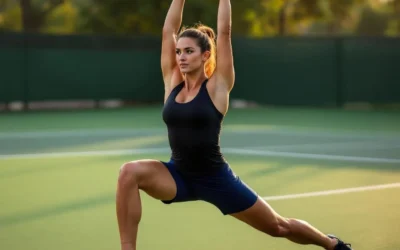
9 Essential Exercises Every Tennis Player Needs
If you’ve spent any time on the court, you know tennis demands more than skill with a racket. The sport asks for sharp reflexes, unbreakable focus, and a body tough enough to endure hours of sprinting, twisting, and striking. So what training should you be doing if you want real results? It’s a question that drives us at Tennis Fitness every day. We chase the answers, test what works, and share it with the players who rely on us for real, practical guidance.
After two decades working with everyone—kids learning the basics, club regulars fighting for their spot, and pros chasing trophies—we’ve carved out a training system built to address the unique challenges tennis throws at your body. Out of this, we distilled what we call the “9 Threads,” a simple but powerful framework that covers every major physical need on court. Maybe these are the best exercises in the world for tennis players, maybe not. What we do know is that through years of sweat and results, they work.
Let’s break down exactly what tennis demands. It’s more than generic fitness. A good player needs strength to explode into a serve, flexibility to reach a deep shot, stamina to outlast tough opponents, and power to finish points. But none of those traits stand alone. We kept asking ourselves, “What’s the real makeup of a complete tennis athlete? What do they look like, feel like, move like on their best day?” Gradually, we saw clear patterns—nine core qualities any great player must embody. Unlocking all nine, you become resilient, explosive—a true force on court.
We call these principles the Martin Method 9 Threads. Here they are, with the best exercise for each—plus a glimpse into why they matter so much.
- Total-Body Strength (Bilateral Power)
This is the foundation—the one thread that underpins the rest. Think of strength as your launching pad. The stronger you are overall, the less you break down and the faster you improve power, speed, and endurance. Our go-to move: the goblet squat. It builds legs and core, supporting every other requirement.
- Rotational Stability & Control
Tennis is a sport of twists and torque. Every stroke fires a chain reaction, transferring force across hips, spine, and shoulders. Control here isn’t optional; it’s the key to both shot power and longevity. Our favorite drill: plate or cable rotations that light up your core and teach you to brace when unleashing a forehand.
- Force Absorption
Sure, everyone wants to hit harder, but if you can’t stop on a dime, you risk injury. Master how to absorb force and you cut wear on your joints. The classic single-leg base land—simple, brutal, effective—trains you to land, brake, and launch again without breaking stride.
- Explosive Power
Power is what snaps a serve past your opponent or drives a backhand crosscourt. Real gains come from sports-specific drills. We lean on the single-arm medicine ball chest throw, a move that mimics coming across a ball with punch and precision.
- Unilateral Power
Tennis is rarely symmetrical: you lunge, sprint, recover, usually off one leg or side. Exercises like single-leg lateral bounds build the confidence to drive off your edge, reach tough shots, and always recover balance.

- Repeating Power
It’s not just one explosive move but the ability to repeat them—again and again. Tennis is a power endurance game, and you need to reload for every shot. Repeated medicine ball hip drives on one leg condition your muscles to deliver burst after burst, point after point.
- Multi-Directional Speed
There’s no straight line in tennis. The ball dictates your path. Box drills add chaos and unpredictability, building the capacity to dash sideways, surge forward, and double back without missing a beat—or a ball.
- High-Efficiency Endurance
Old-school distance jogging just won’t cut it. Instead, our focus is short, tennis-tailored sprints—like grueling court suicides—designed to sharpen both stamina and mental focus so you finish every rally as strong as you started.
- Dynamic Flexibility
Rigid players break down fast. Flexibility, maintained through moves like T rotations, lengthens and restores muscles worn down by rapid, constant motion. Looser muscles and mobile joints equal faster play and less time on the sidelines.
These nine threads aren’t just exercises—they’re guiding principles, touching every part of the tennis athlete’s experience. Whether you’re learning the ropes or fighting to climb the rankings, focusing your training here means you’re taking the best possible care of your body. In short: train smarter, not harder. Stick to these threads, and let your game speak for itself.
Ready to leave the guesswork behind? Our structured programs are built around these nine threads, tested in the heat of competition and fine-tuned over years. Trust the process, put in the work, and discover what your best tennis really feels like.
—
If you’re passionate about helping others discover smarter tennis training, you can also become a Tennis Fitness affiliate. Share proven programs—and start earning by bringing your community closer to their goals.